

Future-Proofing Playbook

Remaining Relevant in the Age of Large Language Models

A Playbook for individuals navigating the labour market

Master’s thesis
Noah Graf
Research question
How can individuals remain relevant in labour markets increasingly shaped by large language models?

Photo by Growtika on Unsplash

The Playbook in brief

Executives do not need another broad AI forecast. They need a clear way to assess their workforce’s exposure to LLMs, choose a strategic response, and act before uncertainty becomes organisational inertia.

The Future-Proofing Playbook provides that structure. It helps executives and employees move from ambiguity to action by guiding them through five steps.

Five-step Future-Proofing Playbook overview

Drill into the Playbook

Select a stage to see more detail.

Build Readiness for Change

Understand the transformation before choosing a response.

Readiness starts with understanding how LLMs reshape labour markets, what is already visible in empirical data, and which mindset helps individuals adapt under uncertainty. The Playbook creates this shared baseline before guiding participants toward concrete strategic choices.

Key outcome

A shared evidence base that moves employees from uncertainty, passivity, or overconfidence toward informed and proactive adaptation.

Understand the Strategic Options

Translate LLM uncertainty into concrete adaptation strategies.

The Playbook introduces the DARE strategies for remaining relevant in labour markets shaped by LLMs: Differentiate through human-centred capabilities, Augment work with LLMs, Reposition toward new value pools, or Evade occupational paths with high LLM exposure.

Key outcome

A holistic understanding of how employees can continue creating value as LLMs reshape work.

Define the Strategic Focus

Match the strategy to role exposure and individual fit.

After clarifying the strategic option space, the Playbook helps identify the most suitable DARE strategy, or combination of strategies, for each individual. It narrows the four options by combining an outside-in view of the individual’s occupational exposure with an inside-out view of their capabilities, learning costs, preferences, constraints, risk tolerance, and time horizon.

Key outcome

A tailored strategic focus that is analytically grounded and realistic for the individual.

Determine the Implementation Pathways

Turn the chosen strategic focus into concrete action.

The Playbook explains step-by-step how each DARE strategy can be implemented in practice: building human-centred capabilities, developing LLM interaction and tool capabilities, identifying and moving into new value pools, or using exposure analysis to guide career pivots.

Key outcome

A practical action agenda that turns the chosen strategy into upskilling priorities, improved work practices, and concrete career moves.

Reassess and Adjust Over Time

Maintain strategic flexibility as new signals emerge.

The Playbook treats the chosen strategic focus and implementation pathways as working hypotheses. Reassessment is triggered when external developments, internal fit and effectiveness signals, or regular review cycles suggest that the underlying assumptions may have changed.

Key outcome

A disciplined review mechanism that prevents both premature strategy revision and clinging to an outdated strategy.

A structured path from uncertainty to action.

This website presents a practical Playbook for individuals who want to remain relevant in labour markets increasingly shaped by large language models.

It does not reduce future-proofing to one skill, one tool, one occupation, or one prediction about the future. Instead, it guides readers through an end-to-end reasoning process: building readiness for change, understanding the strategic options, defining a personal strategic focus, translating that focus into concrete implementation pathways, and reassessing the strategy as technological, economic, societal, political, and individual circumstances evolve.

30-second version

The Playbook turns LLM-driven labour-market uncertainty into a five-step adaptation process: build readiness, compare strategic options, define a personal focus, implement the chosen pathway, and reassess when assumptions change.

Step 1 | Building readiness for change

Readiness starts with understanding the transformation ahead.

Before choosing a strategic response, individuals first need to establish the baseline: how LLMs are reshaping labour markets, which forces drive this transformation, what the current empirical picture shows, and what kind of mindset makes successful adaptation more likely.

The Playbook builds readiness for change through three connected elements: theoretic evidence, empirical evidence, and mindset.

Step 1 in 30 seconds

Future-proofing begins before choosing a strategy. Readers first need theory to understand the forces at play, empirical evidence to see where LLM exposure is already visible, and a growth-oriented mindset to turn uncertainty into action rather than paralysis.

Readiness framework highlighting theoretical evidence Theoretic evidence

What mechanisms reshape work, labour markets, and labour demand?

Readiness framework highlighting empirical evidence Empirical evidence

What effects of LLMs are already visible in real-world data?

Readiness framework highlighting mindset Mindset

What mindset helps individuals adapt successfully?

Step 1 | Building readiness for change: Theoretic evidence

LLMs affect labour markets through three interacting forces.

The Playbook does not start from a simple prediction that LLMs will either destroy jobs or save them. Instead, it uses a task-based perspective to show that different effects can operate at the same time, and can pull labour demand in different directions.

This matters because individuals need to understand not only whether their work is exposed to LLMs, but what kind of exposure they face. Some tasks may become more substitutable. Others may become more productive. And new tasks or roles may emerge as LLM-based systems diffuse across companies.

LLMs should not be understood as only a threat or only an opportunity. Labour-market outcomes depend on the balance between displacement, productivity, and reinstatement effects: displacement can reduce demand for human labour, while productivity and reinstatement can preserve, increase, or create demand where humans remain part of the value chain.

Scenario illustration showing displacement, productivity, and reinstatement effects

Displacement effect

Tasks shift from humans to LLM-based systems, reducing demand for human labour where human contribution becomes substitutable.

Productivity effect

LLMs reduce the cost of producing an output. If this translates into lower prices, the market for that output may expand, increasing demand for the human labour that remains part of its production.

Reinstatement effect

New tasks and roles may emerge as LLMs diffuse across companies, creating new forms of human labour.

Chart of occupational LLM usage depth
Handa et al. (2025)

Handa, K., Tamkin, A., McCain, M., Huang, S., Durmus, E., Heck, S., Mueller, J., Hong, J., Ritchie, S., Belonax, T., Troy, K. K., Amodei, D., Kaplan, J., Clark, J., & Ganguli, D. (2025, February 11). Which economic tasks are performed with AI? Evidence from millions of Claude conversations. View original source

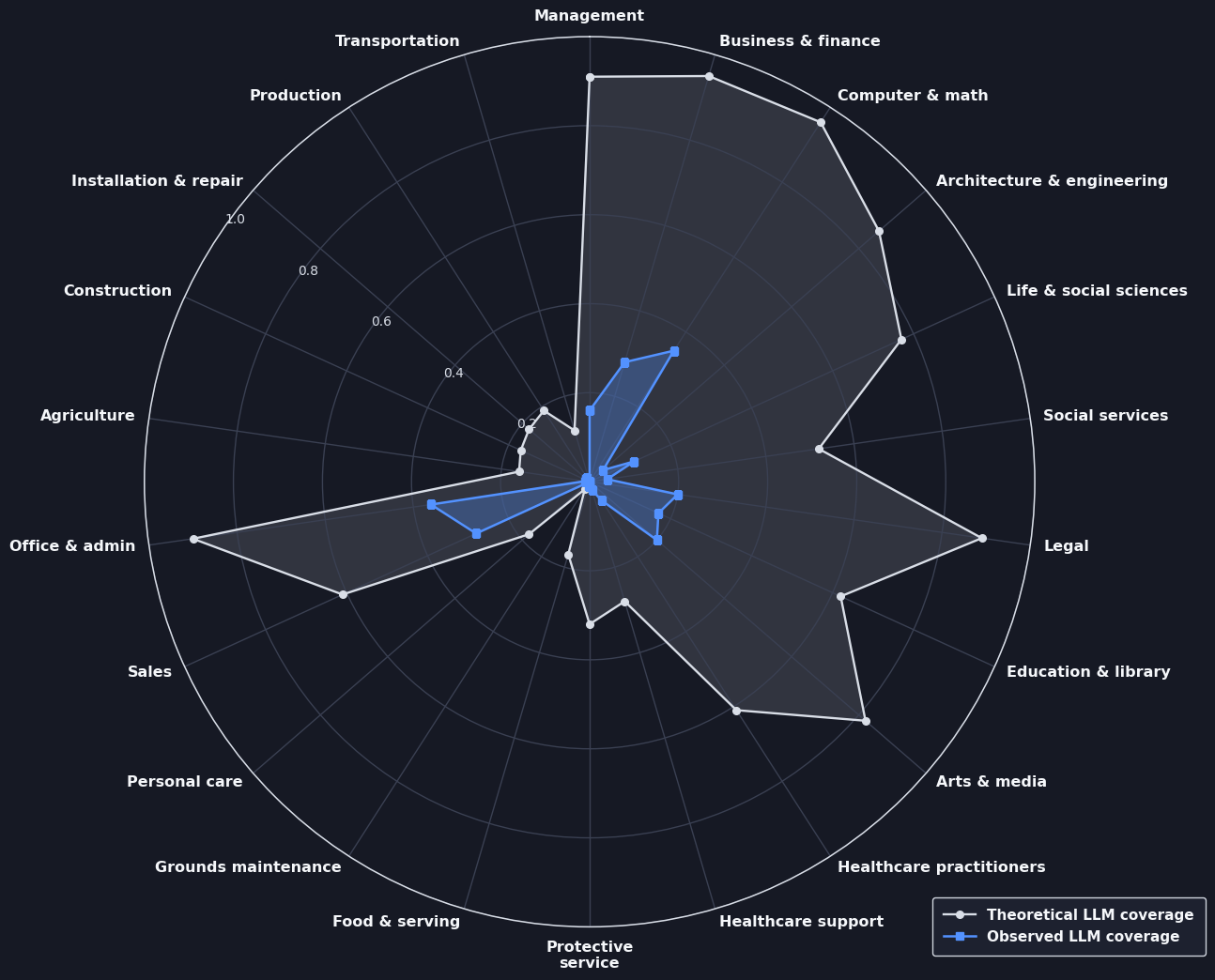
Radar chart of Claude usage across occupational groups
Massenkoff et al. (2026)

Massenkoff, M., McCrory, P., Appel, R., Belonax, T., Bradwell, K., Braden, A., Callender, D., Chaum, M., Clark, M., Eaton, J., Ganguli, D., Handa, K., Heller, R., Karadogan, L., Martinez, J., Mueller, J., Pollack, S., Torres, C. D., & Clark, J. (2026, March 5). Labour market impacts of AI: A new measure and early evidence. Anthropic. View original source

Step 1 | Building readiness for change: Empirical evidence

The labour-market transformation is still at an early stage.

The empirical part of the Playbook connects retrospective and prospective perspectives.

Retrospective evidence suggests that LLM adoption and usage are rising, but remain uneven and still at an early stage. At the same time, observed employment effects remain heterogeneous, with emerging evidence of adverse impacts in specific areas, such as entry-level work and technical occupations.

Prospective evidence points to a different but complementary picture. Exposure analyses show that many occupations, functions, and industries contain tasks that LLMs could automate, augment, or reorganize. While this reflects theoretical coverage rather than guaranteed labour-market outcomes, it highlights the scale of potential labour-market disruption if LLMs are widely adopted.

A storm may lie ahead, and we must prepare now if we are to dance in the rain.

Nascent labour-market effects Uneven occupational usage High task-level exposure variance

The empirical picture supports proactive preparation, not panic. Deep economy-wide integration of LLMs remains limited, and visible labour-market effects are still uneven and heterogeneous. However, exposure to LLMs is substantial across occupations, functions, and industries, suggesting that the current window should be used to adjust one’s labour-market strategy before adjustment pressures become more visible and disruptive.

Step 1 | Building readiness for change: Mindset

Future-proofing requires the right mindset.

The Playbook recognises that the labour-market effects of LLMs are an emotionally charged topic. Discussions often fall into three unproductive postures: alarmism, dismissiveness, or techno-optimism. Each captures part of the debate, but each can also weaken an individual's ability to adapt effectively.

The Playbook therefore recommends adopting what is often referred to as a growth mindset, applied here to LLM-driven labour-market change: the willingness to experiment, question familiar routines, tolerate temporary incompetence during upskilling or reskilling, and rebuild competence as work changes. This mindset does not guarantee success, but it increases the chances of adapting early, before change becomes unavoidable.

Circular framework connecting theoretical evidence, empirical evidence, and mindset

With the baseline established — theoretical evidence, empirical evidence, and mindset — individuals can now move to the strategic options for remaining relevant in LLM-infused labour markets.

Step 2 | Understanding the strategic options

The DARE strategies define four pathways for remaining relevant in LLM-infused labour markets.

The four strategies differ along two questions: where the individual acts, and why the individual acts. The first asks whether relevance should be strengthened through reskilling and upskilling or through a changed labour-market position. The second asks whether the move is opportunity-driven, seeking to leverage AI tailwinds, or avoidance-driven, reducing exposure to AI headwinds.

The acronym is deliberately active. DARE frames future-proofing as a choice to act under uncertainty, rather than waiting for labour-market adjustment to become obvious.

Step 2 in 30 seconds

DARE defines the strategic option space: differentiate through human-centred capabilities, augment current work with LLMs, reposition toward areas where LLMs may increase demand, or evade high-substitutability paths.

DARE strategy map with skill set, positioning, opportunity, and avoidance axes

Differentiation

Build human-centred capabilities that remain difficult to replicate.

Strengthen capabilities where humans retain a comparative advantage, such as empathy, judgment, creativity, and leadership. The goal is not to compete with LLMs on their strengths, but to deepen human contribution where LLMs remain weaker.

Human Edge Low Substitutability EPOCH Capabilities

Step 2 defines the option space for future-proofing strategies. Differentiation and augmentation primarily challenge the current skill set and work practices. Repositioning and evasion challenge the labour-market position. Together, the DARE framework helps readers confront both the opportunities and the risks created by LLMs.

Step 3 | Defining the strategic focus

Deciding the strategic focus connects occupational exposure with personal fit.

After understanding the strategic option space, the next step is to decide which strategy, or compatible combination of strategies, to pursue — the strategic focus.

The Playbook uses a funnel-like structure that progressively narrows the four strategic options. It first takes an outside-in perspective on the current or targeted occupation, depending on whether the individual is already in the workforce or about to enter it, before turning to an inside-out perspective on the individual’s situation and preferences.

The outside-in analysis asks, based on the respective occupational exposure, whether differentiation or augmentation within the current career path may be sufficient, or whether a more substantial move toward repositioning or evasion is needed. The inside-out analysis then asks whether the remaining options fit the person’s capabilities, risk tolerance, learning preferences, constraints, and time horizon.

The resulting strategic focus may consist of a single strategy or a compatible combination. Differentiation is the most flexible option. Augmentation combines well with differentiation or repositioning. Repositioning and evasion are mutually exclusive, while evasion is only meaningfully compatible with differentiation.

Step 3 in 30 seconds

Strategic focus is where analysis becomes choice. The thesis uses occupational exposure to judge whether light or larger adjustments are needed, then tests the remaining strategies against personal fit so the chosen focus makes sense analytically and practically.

Three-step funnel for understanding occupational exposure, assessing personal fit, and defining the strategic focus
Strategic focus builder

Choose the strategy depth first, then inspect the concrete focus options.

Step 3 converts the strategic option space into a concrete strategic focus. It first uses exposure analysis to identify whether light or larger adjustments are needed. It then assesses how each remaining strategy fits the individual’s circumstances, helping decide which strategy or combination makes sense both analytically and practically.

Step 4 | Determining the implementation pathways

Each strategy requires a different implementation pathway.

This stage of the Playbook turns each strategic option into a concrete implementation pathway. It outlines how differentiation, augmentation, repositioning, and evasion can be implemented in practice. While kept high-level here, the full Playbook offers step-by-step guidance.

Step 4 in 30 seconds

Implementation depends on the chosen strategy: train human-centred capabilities for differentiation, build interaction and tool capability for augmentation, identify demand channels for repositioning, or use exposure evidence to guide lower-exposure moves.

Human-centred capabilities connected to TRACOM and complex problem-solving training routes
Differentiation

Train the human layer.

The Playbook identifies distinct human-centred capabilities that remain relevant for the future and explains how individuals can build them deliberately.

  • It covers 13 human-centred capabilities: empathy, emotional intelligence, presence, networking, connectedness, opinion, judgment, ethics, creativity, imagination, hope, vision, and leadership.
  • The Playbook connects these human-centered capabilities to practical development approaches.
AI productivity tools wheel Human and LLM interaction capability visual
Augmentation

Leverage LLMs.

The Playbook shows how individuals can build LLM literacy to increase the value of their work.

  • It focuses on interaction capability: knowing when and how to engage with LLMs, including prompting, feedback, iteration, evaluation, and oversight.
  • It also covers tool capability: knowing which AI tools fit which workflow, and when a general-purpose LLM is not enough.
Six labour-demand channels created by LLM adoption
Repositioning

Move toward new value pools.

The Playbook shows how LLM adoption may create new or expanded demand for human labour in specific tasks, roles, functions, or sectors.

  • It identifies six labour-demand channels that may emerge from LLM adoption.
  • It helps individuals assess which demand channels are most relevant to their specific situation.
Occupational exposure analysis tables showing automation, augmentation, lower potential, and non-language tasks
Evasion

Move toward lower exposure occupations.

The Playbook analyses occupational, functional, and industry groups to show where LLM exposure is comparatively stronger or weaker.

  • It distinguishes, for each occupation, function, and industry group, which parts of work may be automated, augmented, less affected by LLMs, or not affected at all.
  • It helps individuals compare exposure patterns and identify where lower-exposure moves may be worth considering.

Step 4 turns the chosen strategic focus into action. It provides practical implementation pathways for each future-proofing strategy, focusing on high-leverage actions that are realistic to pursue alongside other professional and personal responsibilities.

Step 5 | Reassessing and adjusting over time

The Playbook is iterative because the future is still moving.

Future-proofing is not a one-off exercise. The strategic focus and implementation pathways are working hypotheses whose validity depends on assumptions about the labour market, technological progress, and the individual’s own situation.

To identify when iteration may be needed, the Playbook uses three types of triggers: external, internal, and time-based. This creates a disciplined way to reassess the strategy, avoiding both constant adjustment and clinging to an outdated strategy after the underlying assumptions have changed.

Step 5 in 30 seconds

The Playbook is iterative because assumptions can break. Reassessment is triggered by external labour-market or technology evidence, internal fit and effectiveness signals, and regular review cycles, so the reader returns only to the earliest step that needs revision.

Step 5 turns the Playbook into a continuous process rather than a one-off exercise. Reassessment can be based either on ongoing monitoring of external and internal triggers or on regular review cycles. In both cases, if a need for adjustment is identified, the reader should return to the earliest step in the Playbook whose assumptions have changed and proceed from there.

Assumption breakers

Use the triggers below to check whether the current strategic focus and implementation pathways still hold. For a more rigorous approach, monitor external and internal triggers as they emerge; for a lighter approach, use time-based triggers to reassess the pathway at regular intervals.

Individuals face a choice between two forms of friction: the friction of remaining passive while worrying about the future, or the friction of actively challenging familiar ways of working.

The friction is unavoidable. Which one you choose is not.

From friction to agency.

This website offers a first glimpse into the Future-Proofing Playbook. The full Playbook goes substantially deeper and can be translated into different session formats depending on the audience.

Companies

Build a shared language for LLM-driven workforce change.

Many companies are discussing LLM adoption and workforce transformation, but successful implementation depends on workforce buy-in. The Playbook helps employees understand what LLMs mean for their work, while giving leaders a simple structure for turning uncertainty into practical conversations about skills, roles, and organizational adaptation.

Example session formats
  • Strategic workshop on future-ready skills, augmentation opportunities, and adaptation pathways
  • LLM exposure analysis across company, role, and workflow levels to identify where LLMs will disrupt the status quo
  • Team session to reduce uncertainty and turn AI anxiety into practical role-level action

Contact

Interested in the full insights?

The Future-Proofing Playbook is based on an in-depth master’s thesis that combines rigorous research, empirical labour-market data, and expert interviews.

For audiences interested in applying the insights in practice, I offer tailored session formats and access to the full research report as part of a broader engagement.

Why executives engage

Stay ahead of the curve

Turn proactive workforce adaptation into a competitive edge.

Shape the people strategy

Translate LLM exposure into decisions on upskilling, role redesign, and organisational adaptation.

Unlock human–AI performance

Design smarter workflows that combine AI productivity with human strengths.

Protect workforce energy

Reduce fear, confusion, and passivity before they hurt engagement and productivity.

Save time

A focused briefing on what leaders need to know about AI and its impact on labour markets and the workforce.

Best next step

For a keynote, team upskilling, strategic workshop, or full thesis insight session, choose a format and send a short note. The form opens a pre-filled email to Noah.

Book an executive session.

Interested in

Several organisations have already drawn on this work to shape conversations on how individuals, teams, and leaders can remain relevant in the age of LLMs.

EY
EY-Parthenon
Change & Sustain
E4S
University of Neuchâtel
Portrait of Noah Graf

Author

Noah Graf

MSc in Management, Technology, and Sustainability, jointly delivered by EPFL, IMD, and HEC Lausanne.

LinkedIn